

One of the most practical questions a student can ask before committing to a degree is: What will this qualification actually earn me? For BCA students and prospective applicants, that question deserves a clear, honest, and detailed answer — not a vague range dressed up as a salary guide.
When asked what about BCA, from a career and earnings perspective, it is a genuinely encouraging answer in 2026. India’s technology sector continues to expand, digital adoption across industries is accelerating, and the demand for application developers, IT professionals, and software support personnel remains high. BCA graduates are entering a market that has not contracted around their profile — it has grown around it.
What follows is a grounded, stage-by-stage breakdown of what BCA graduates earn at each point in their career, what roles drive the highest compensation, what factors separate the top earners from the average, and what the trajectory looks like over five to ten years.
Understanding what BCA is for is essential before interpreting salary data, because the degree’s scope directly determines the range of roles — and therefore the range of compensation — available to its graduates.
The Bachelor of Computer Applications is a three-year undergraduate program that builds applied competency in software development, programming, database management, networking, web technologies, and systems analysis. It is designed to produce graduates who can contribute to technology functions across industries from the first year of employment, not after extended on-the-job training.
This applied orientation is what makes the BCA’s salary trajectory meaningful. A graduate who can write functional code, manage a database, support a web application, or administer IT systems is solving real problems for employers from day one. Salaries in the technology sector have consistently reflected the value of that immediate contribution, which is why BCA fresher packages in 2026 compare favourably to many other undergraduate disciplines.
Key Takeaway: Salary follows value. The BCA’s skills-first design means graduates can contribute from the outset — and early contribution is what separates technology compensation from that of many other undergraduate paths.
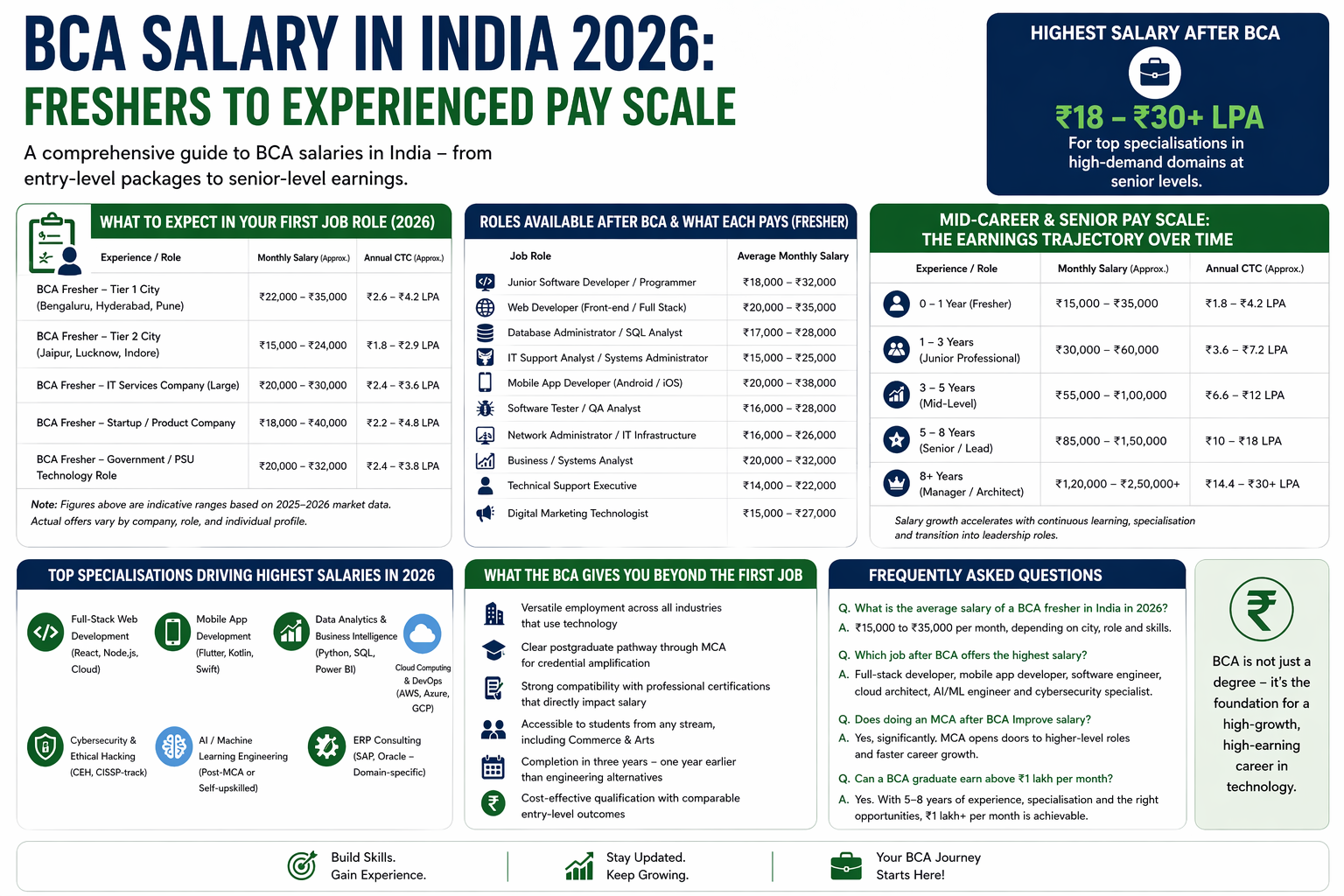
The salary after BCA per month for freshers in 2026 varies by role, city, company type, and the candidate’s demonstrable skill level. A broadly accurate picture for most BCA graduates entering their first technology role falls in the range of ₹15,000 to ₹35,000 per month, with the median for most entry-level IT positions sitting between ₹18,000 and ₹25,000.
This range reflects a wide spectrum of employers. Large IT services companies, government-linked technology departments, mid-sized software firms, startups, and non-IT companies with in-house technology teams all hire BCA graduates at different entry packages. Location plays a significant role: the same role in Bengaluru, Hyderabad, or Pune will typically offer 20 to 35 per cent more than the same role in a tier-2 city.
| Experience / Role | Monthly Salary (Approx.) | Annual CTC (Approx.) |
|---|---|---|
| BCA Fresher – Tier 1 City (Bengaluru, Hyderabad, Pune) | ₹22,000 – ₹35,000 | ₹2.6 – ₹4.2 LPA |
| BCA Fresher – Tier 2 City (Jaipur, Lucknow, Indore) | ₹15,000 – ₹24,000 | ₹1.8 – ₹2.9 LPA |
| BCA Fresher – IT Services Company (Large) | ₹20,000 – ₹30,000 | ₹2.4 – ₹3.6 LPA |
| BCA Fresher – Startup / Product Company | ₹18,000 – ₹40,000 | ₹2.2 – ₹4.8 LPA |
| BCA Fresher – Government / PSU Technology Role | ₹20,000 – ₹32,000 | ₹2.4 – ₹3.8 LPA |
Note: Figures above are indicative ranges based on 2025–2026 market data. Actual offers vary by company, role, and individual profile.
Key Takeaway: Fresher salaries for BCA graduates in 2026 are competitive relative to many non-technical undergraduate degrees, particularly in technology-dense cities. The ceiling within the fresher range is pushed upward by demonstrable skill, not just the degree itself.
The question of what jobs are available after completing BCA has a wider and more varied answer than many students expect. The degree does not funnel graduates into a single career track. It opens several parallel paths, each with its own compensation profile and growth trajectory.
| Job Role | Average Monthly Salary (Fresher) |
|---|---|
| Junior Software Developer / Programmer | ₹18,000 – ₹32,000 |
| Web Developer (Front-end / Full Stack) | ₹20,000 – ₹35,000 |
| Database Administrator / SQL Analyst | ₹17,000 – ₹28,000 |
| IT Support Analyst / Systems Administrator | ₹15,000 – ₹25,000 |
| Mobile App Developer (Android / iOS) | ₹20,000 – ₹38,000 |
| Software Tester / QA Analyst | ₹16,000 – ₹28,000 |
| Network Administrator / IT Infrastructure | ₹16,000 – ₹26,000 |
| Business / Systems Analyst | ₹20,000 – ₹32,000 |
| Technical Support Executive | ₹14,000 – ₹22,000 |
| Digital Marketing Technologist | ₹15,000 – ₹27,000 |
Key Takeaway: The role a BCA graduate chooses at the entry level has more influence on long-term compensation than almost any other early career decision. Roles in software and web development offer both strong starting packages and the steepest growth curves.
Salary in the technology sector is not linear. The jump from fresher to junior professional, and from junior to senior, often involves significant percentage increases rather than modest annual increments. BCA graduates who invest in continuous skill development experience these jumps at a pace that outstrips many other graduate profiles.
| Experience / Role | Monthly Salary (Approx.) | Annual CTC (Approx.) |
|---|---|---|
| 0 – 1 Year (Fresher) | ₹15,000 – ₹35,000 | ₹1.8 – ₹4.2 LPA |
| 1 – 3 Years (Junior Professional) | ₹30,000 – ₹60,000 | ₹3.6 – ₹7.2 LPA |
| 3 – 5 Years (Mid-Level) | ₹55,000 – ₹1,00,000 | ₹6.6 – ₹12 LPA |
| 5 – 8 Years (Senior / Lead) | ₹85,000 – ₹1,50,000 | ₹10 – ₹18 LPA |
| 8+ Years (Manager / Architect) | ₹1,20,000 – ₹2,50,000+ | ₹14.4 – ₹30+ LPA |
Key Takeaway: BCA graduates who treat their degree as the beginning of a learning journey follow a salary trajectory that is among the more compelling in India’s graduate employment landscape.
Specialisation is the bridge to the highest pay brackets. In 2026, BCA graduates in high-demand specialisations can command packages in the range of ₹18 to ₹30+ LPA at senior levels.
Specialisations driving the highest BCA salaries:
Key Takeaway: The highest-earning BCA graduates chose high-demand specialisations early and invested consistently in staying current within them.
The benefits of the BCA course go beyond the initial paycheck. The degree delivers versatility across industries, a clear postgraduate pathway (MCA), and high compatibility with industry-recognised certifications.
Key Takeaway: The BCA’s benefits compound over time. It is a foundation that supports postgraduate study, professional certification, career pivots, and long-term salary growth.