

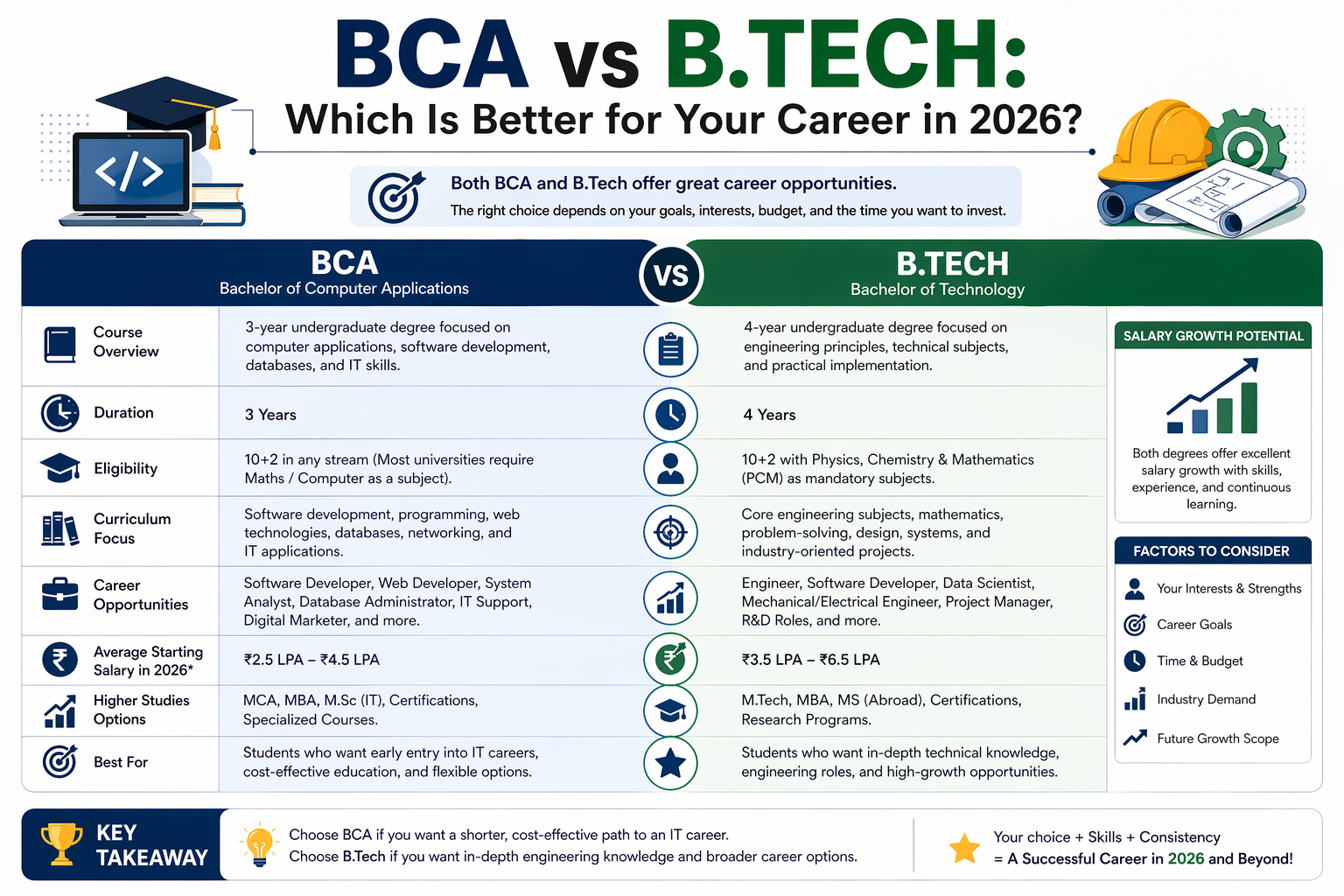
It is one of the most searched questions among students finishing their Class 12: BCA or B.Tech? Both lead into the technology sector. Both are undergraduate degrees. Both open doors to software, IT, and digital careers. And yet they are fundamentally different programs — in structure, depth, cost, duration, and the kind of professional they are designed to produce.
The confusion is understandable. When the end destination appears similar — a career in technology — the path differences can seem like minor details. They are not. Choosing between BCA and B.Tech is a decision that will shape the next three to four years of academic life, the cost of that education, the type of roles available at graduation, and the trajectory of the career that follows.
This guide does not declare a universal winner. It maps the genuine differences between the two programs and gives students the framework to decide which one is right for their specific profile, goals, and circumstances.
The difference between BCA and BTech begins with the fundamental nature of each degree. A Bachelor of Computer Applications (BCA) is a three-year undergraduate program focused on software, applications, and computer science theory. A Bachelor of Technology in Computer Science or IT (B.Tech CS/IT) is a four-year engineering undergraduate program that covers computing within a broader engineering framework, including mathematics, electronics, and systems-level thinking.
The BCA is classified under the faculty of science or computer applications. The B.Tech is classified as an engineering degree. This distinction carries implications for higher education pathways, government recruitment eligibility, and employer perception — all of which are worth understanding before choosing.
| Parameter | BCA | B.Tech (CS/IT) |
|---|---|---|
| Degree Type | Bachelor of Computer Applications | Bachelor of Technology (Engineering) |
| Duration | 3 years (6 semesters) | 4 years (8 semesters) |
| Stream | Science / Computer Applications | Engineering |
| Entry Requirement | 10+2 any stream, typically 45–50% | 10+2 Science (PCM), typically 50–60% |
| Core Focus | Software, applications, programming | Engineering + CS fundamentals |
| Maths Requirement | Often optional or basic | Physics, Chemistry, Maths mandatory |
| Program Depth | Applied, industry-oriented | Technical, research + industry |
| Typical Cost | Lower across public and private institutions | Higher, significantly so for private colleges |
| Post-Grad Path | MCA, MBA, M.Sc (CS) | M.Tech, MBA, MS abroad |
| Govt Job Eligibility | Varies by post; some require an engineering degree | Broader eligibility for engineering cadre posts |
Key Takeaway: BCA and B.Tech are not interchangeable paths to the same destination. They are distinct programs with different depths, durations, costs, and post-graduation trajectories — and the right choice depends on where a student is starting from and where they intend to go.
What is the scope of BCA? The question has a more substantial answer in 2026 than it did five years ago. The program has matured considerably as the demand for application developers, software professionals, and IT generalists has grown across industries — and as the quality of BCA programs offered by established universities has improved.
A well-designed BCA curriculum covers: programming in C, C++, Java, and Python; data structures and algorithms; database management and SQL; operating systems; computer networks; web development; software engineering principles; mathematics for computing; and increasingly, subjects aligned with emerging technology areas such as cloud computing, cybersecurity, and data analytics.
When students ask how many subjects are in the BCA, the answer across a standard three-year program is typically 30 to 40 subjects spread across six semesters, depending on the university and its curriculum design. The coverage is deliberately broad in the first year and increasingly specialised in the second and third. This structure produces a graduate who is technically competent across a wide range of computing domains, rather than deeply specialised in a narrow area.
What are the uses of BCA course? The question is best answered by looking at where BCA graduates actually go. Entry-level roles in software development, web development, database administration, IT support, system analysis, mobile application development, and technical content creation are all directly accessible to BCA graduates. The degree also qualifies students for MCA admission — the standard postgraduate route for those who want to deepen their computing specialisation after the undergraduate years.
Key Takeaway: The BCA is not a diluted version of a computer science engineering degree. It is a differently designed program — more applied, more directly career-oriented, and more accessible — that produces graduates who are employment-ready in the technology sector across a broad range of entry-level and junior roles.
The B.Tech in Computer Science or IT is an engineering degree, and that classification carries genuine significance. It is the degree that makes a graduate eligible for engineering cadre government positions, which most large technology companies have historically used as a baseline hiring credential, and that opens the most direct path to M.Tech and research-oriented postgraduate study.
The engineering framework means the B.Tech goes deeper into computing fundamentals: computer architecture, theory of computation, advanced algorithms, compiler design, digital electronics, and signal processing are all part of a standard curriculum. The mathematical rigour is also higher — subjects like discrete mathematics, linear algebra, and probability theory are treated as core, not optional.
This depth comes with a corresponding investment: four years instead of three, a higher typical fee, and a significantly harder entry requirement (Physics, Chemistry, and Mathematics at 10+2 are mandatory, and most credible B.Tech programs are competitive in admissions). For students who are strong in mathematics, interested in systems-level computing, and prepared to invest an additional year, the B.Tech returns that investment with the breadth of engineering credentials it confers.
Key Takeaway: The B.Tech earns its longer duration and higher cost through engineering depth and the broader credential it confers. It is the right choice for students who are genuinely mathematics-oriented and interested in the full engineering stack of computing, not just its applications layer.
A common misperception is that students choose BCA because they could not get into B.Tech. For some, that may be true. But for a growing number of students, BCA or BTech, why choose BCA has a considered answer: because the BCA is the program that better fits their profile, their timeline, and their career goals.
Students from Commerce or Arts backgrounds who did not study Mathematics or Physics at the 10+2 level are ineligible for most B.Tech programs. For them, BCA is not a compromise — it is the only viable undergraduate route into the technology sector, and it is a fully credible one.
Students who want to enter the workforce a year earlier — at 21 rather than 22 — and who do not need the engineering designation to achieve their career goals are making a rational choice by completing a BCA and entering employment or a postgraduate program sooner.
Students who want to pursue an MBA in information technology, a career in IT sales or consulting, or a role in digital marketing or e-commerce find that a BCA provides a sufficient and appropriate technical foundation without the additional engineering depth that those careers do not require.
BCA is the stronger choice when:
Key Takeaway: Choosing BCA over B.Tech is not a decision made by default. For a specific and substantial profile of students, it is the more appropriate, more accessible, and more strategically sound choice.
One of the most common moments where this decision surfaces is during interviews. Why you choose BCA interview questions is asked precisely because recruiters want to understand whether the candidate made a deliberate, reasoned decision or simply followed the path of least resistance. The answer matters — not because B.Tech is inherently superior, but because a candidate who can articulate their reasoning demonstrates self-awareness and intentionality that recruiters value.
A strong answer is one that is honest and specific. It acknowledges what the BCA provides, how it aligns with the career direction being pursued, and why the program was the right fit for that particular student’s background and goals. Candidates who try to position their BCA as equivalent to B.Tech in every respect miss the point. The two degrees are different — and owning those differences confidently, while connecting them to genuine professional capability, is what impresses.
A well-prepared BCA graduate who can speak clearly about what they studied, what they built during the program, and what they intend to develop further is consistently more compelling in a hiring context than a B.Tech graduate who treats their degree as a credential to display rather than a foundation to build on.
Key Takeaway: The question ‘why did you choose BCA?’ is an opportunity, not a challenge. Candidates who answer it with clarity and conviction — connecting the degree to their specific goals and demonstrating what they built with it — consistently outperform those who are defensive or apologetic about the choice.
In 2026, the technology hiring market has matured enough that the BCA versus B.Tech distinction is evaluated more nuancedly than it was a decade ago. Leading firms in IT services, product development, and digital services assess candidates primarily on demonstrated capability: can they write code, understand systems, solve problems, and communicate technically? The degree is a starting filter, not the final word.
That said, certain role categories and certain employers continue to use the engineering degree as a baseline requirement. Core software engineering roles at large product companies, embedded systems positions, hardware-adjacent computing roles, and government engineering cadre jobs often require a B.Tech. For these specific targets, B.Tech remains the clearer path.
For the broader landscape of IT employment — application development, web and mobile technologies, database management, IT operations, digital marketing technology, ERP support, and technical consulting — a BCA from a credible institution, supplemented by relevant certifications and demonstrated project work, positions a graduate effectively.
Roles most accessible to BCA graduates in 2026:
Key Takeaway: In the 2026 hiring market, the BCA graduate who has built demonstrable skills — through projects, internships, and certifications — competes effectively for the majority of entry-level and junior technology roles. The degree opens the door; what the candidate brings in closes the offer.
Our counselling team is ready to assist you at every step — click the button below to get started.
Need advice? Our experts are on WhatsApp 24/7—message us anytime!
