

Somewhere between finishing school and choosing a college, a growing number of students and parents are asking a version of the same thing: is Online BBA worth it, or is it a shortcut that looks convenient on paper but falls short where it actually matters? The question deserves a straight answer rather than a defensive one.
Worth is not a fixed property of a format. It depends entirely on whether the specific programme is properly recognised, whether the curriculum builds real business skills, and whether the candidate treats it with the seriousness a degree deserves. A flexible-format undergraduate business qualification from a properly accredited institution can absolutely hold its own against a campus-based one. A poorly chosen, unrecognised one cannot, regardless of the format attached to it. The rest of this piece separates the two.
A few years ago, flexible-format undergraduate degrees were a relatively niche choice, often selected only when a campus option genuinely wasn't available. That has changed considerably. More established universities now offer fully recognised flexible-format undergraduate business programmes, hiring managers have grown noticeably more comfortable with candidates who studied this way, and remote-first and hybrid workplaces have normalised the idea that structured, self-directed learning is a legitimate professional skill rather than a compromise.
At the same time, the sheer number of new providers entering this space has made quality control a genuine concern. Not every flexible-format programme carries the same weight, and that inconsistency is exactly what feeds the scepticism behind this entire conversation.
Much of the anxiety around this decision actually comes down to one specific concern, phrased almost identically by thousands of applicants each year: is Online BBA valid in India? The answer depends entirely on whether the offering university and the specific programme carry valid approval from the relevant higher education regulatory body. When that approval is in place, a flexible-format undergraduate business degree carries the same legal and academic standing as its campus-based counterpart, is eligible for further postgraduate study, and is accepted for most private-sector recruitment and many public-sector eligibility criteria as well.
The confusion usually stems from a handful of unrecognised providers operating without proper approval, whose degrees genuinely do carry limited value. Painting the entire format with that same brush is where the real misunderstanding begins.
It is worth addressing the harshest version of this doubt directly, since it circulates widely online: is Online BBA useless? The honest answer is that the format itself is not the deciding factor; execution is. A flexible-format degree becomes genuinely weak when a candidate treats it passively, skips project work, and expects the certificate alone to do the talking. The exact same failure pattern exists among campus-based students who coast through three or four years without building real skills. The format did not cause either outcome; the level of engagement did.
What tends to separate a valuable flexible-format experience from a hollow one is whether the curriculum includes case studies, live projects, internships, or practical assessments, rather than being built entirely around passive reading and rote memorisation.
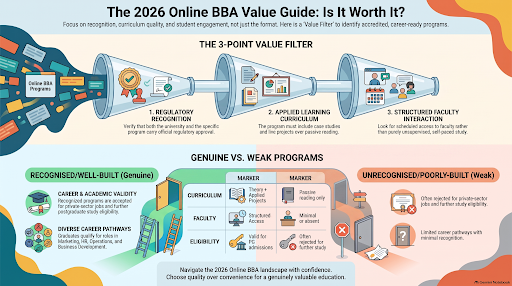
Because “worth it” depends on specifics rather than the format label alone, it helps to run any programme being considered through four checks together. Call this the Undergraduate Value Filter: Is the offering university and the specific programme properly recognised by the relevant regulatory body? Does the curriculum include applied, practical components rather than purely theoretical content? Does the institution offer any placement, internship, or industry-exposure support? And is there a genuine faculty interaction component, rather than a purely self-paced, unsupervised structure? A programme that clears all four checks is very likely to be worth the time and money invested. One that fails even two of them deserves a much closer look before enrolling.
A large share of applicants asking about this format are still in school or have just finished it, which brings up a very practical version of the worth question: Can I do Online BBA after 12th? In most cases, yes. Recognised flexible-format undergraduate business programmes are generally open to students straight out of Class 12, without requiring prior work experience, making this a genuinely viable first-degree option rather than something reserved only for working professionals returning to study later in life.
For a school-leaver, the appeal usually comes down to a different kind of flexibility than what a working professional seeks. Rather than balancing a job around study, a younger student typically values the ability to build practical skills, internships, or even a small venture alongside their coursework, something a rigid, fully scheduled campus timetable does not always accommodate as easily.
Since so much of the worth debate comes down to spotting the difference between a properly built programme and a hollow one, it helps to lay the distinguishing markers out directly rather than leaving them implied.
| Marker | Recognised, Well-Built Programme | Unrecognised or Poorly-Built Programme |
|---|---|---|
| Regulatory approval | Held by both the university and the specific programme | Often missing or unclear |
| Curriculum design | Mix of theory, case studies, and applied projects | Largely passive reading with minimal application |
| Faculty interaction | Scheduled, structured access to faculty | Minimal or entirely absent |
| Assessment method | Proctored, formally evaluated | Loosely monitored or self-certified |
| Placement or industry support | Actively offered | Rarely offered |
| Further study eligibility | Accepted for postgraduate admissions | Often questioned or rejected |
Running any shortlisted programme against this table takes the guesswork out of the decision far more effectively than relying on general reputation alone.
When the programme is properly chosen, the career direction it supports is genuinely broad. Graduates typically move into roles such as:
For a school-leaver in particular, this range of options matters more than it might for someone already established in a career, since it is often their first real exposure to structured business thinking.
When parents raise concerns about this format, the real question is rarely about the format itself. It is almost always about whether the certificate will be respected later, whether the son or daughter will actually study seriously without a physical classroom holding them accountable, and whether the fees represent a fair investment. All three concerns are addressed the same way: confirming recognition status directly through official records, checking whether the curriculum includes genuine assessment and faculty interaction, and treating the fee structure with the same scrutiny as any other financial decision. Once these three boxes are ticked, most of the underlying anxiety tends to resolve on its own.
The gap in perceived credibility between flexible-format and campus-based undergraduate business degrees is likely to keep narrowing as more established universities enter this space and regulatory oversight matures further. At the same time, the market is likely to keep sorting itself, with well-built, properly recognised programmes gaining ground while weaker, unaccountable providers gradually lose relevance as employers and students alike become more discerning about what they are actually signing up for.
Rather than treating this as a binary “worth it or not” question, it is far more useful to run the programme actually being considered through the checks laid out above. A recognised institution, a curriculum with real applied content, some form of structured interaction, and a fee that matches the value delivered together answer the worth question far more reliably than any general opinion about the format as a whole.
Generally, yes, provided the offering university and specific programme are properly recognised by the relevant regulatory body. Most private-sector recruiters focus more on skills and project experience than on the format the degree was completed in.
Yes, as long as the programme holds valid recognition. A properly approved flexible-format undergraduate degree carries the same eligibility for further study as a campus-based one.
The most reliable way is to verify the approval status of both the offering university and the specific programme directly through the relevant regulatory body's official records, rather than relying on claims made in advertisements.
Yes. Most recognised programmes in this format are open to students straight out of Class 12 and do not require any prior work experience to enrol.
Prioritising a low fee or flashy marketing over checking recognition status and curriculum quality. A cheap, unrecognised programme almost always costs more in the long run than a slightly pricier, properly accredited one.
Our counselling team is ready to assist you at every step — click the button below to get started.
Need advice? Our experts are on WhatsApp 24/7—message us anytime!
