

India's IT and software services sector continues to hire faster than most other industries, and a growing share of that hiring now favours candidates who can show applied, project-tested skills alongside a recognised postgraduate qualification.
This is a postgraduate degree in computer applications, delivered by a UGC-recognised deemed university through its Centre for Distance and Online Education, and structured around a mix of live weekend sessions, recorded lectures, assignments, and guided projects. It is built for two kinds of learners in particular: working professionals who want a formal technical postgraduate credential without leaving their job, and recent graduates who prefer a flexible, self-paced route into the technology sector.
For working graduates who cannot pause a job to sit in a classroom, a well-structured online postgraduate programme in computer applications is increasingly the practical route into that hiring pool, provided the fees, admission process, and curriculum are understood clearly before enrolling.
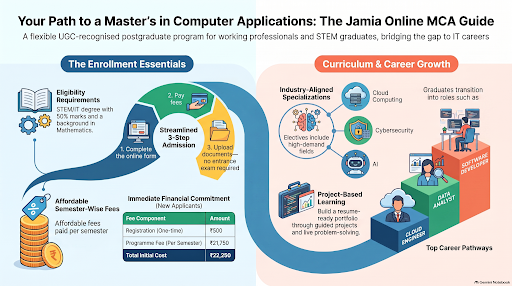
A clear picture of Jamia Online MCA fees is usually the first thing a prospective student wants, and the structure here is straightforward: a one-time registration or application fee, followed by a programme fee charged each semester across the duration of the course.
| Fee Component | Amount |
|---|---|
| Registration / Application Fee (one-time) | ₹500 |
| Programme Fee (per semester) | ₹21,750 |
This fee structure is charged per semester rather than as a single lump sum, which makes budgeting considerably easier for a working learner paying out of an ongoing salary rather than a loan taken upfront.
Eligibility for this programme is fairly specific, and worth checking carefully before beginning the application:
The Jamia Online MCA admission process is designed to be completed entirely online, without requiring a campus visit, and follows three straightforward stages.
A candidate begins by completing the application form online, entering personal, academic, and contact details accurately, since these are later cross-checked against submitted documents.
Once the form is submitted, the next step is completing the fee payment securely through the university's online payment gateway, confirming the applicant's seat in the intake.
The final step involves uploading the required academic and identity documents for verification, after which the admission is processed and confirmed by the university.
Prospective students researching the Jamia Online MCA syllabus will find a curriculum built around the same core computer science foundations found in most recognised postgraduate computer applications programmes, supplemented by electives aligned to current industry demand.
Core areas typically covered across the semesters include:
Elective and advanced modules generally include:
The programme also builds in project-based work, where learners apply these concepts to a live problem under faculty guidance, which is often the component that adds the most weight to a resume when applying for technical roles afterwards.
Rather than deciding based on cost or convenience alone, it helps to run the decision through four checks together; call it an enrolment fit framework since each one addresses a different risk of enrolling in the wrong programme.
Does the academic background genuinely meet the mathematics and subject requirements, rather than assuming a borderline case will be accepted?
Can the semester-wise fee be comfortably absorbed alongside existing income and expenses, without financial strain building up over the four semesters?
Is there realistically enough time each week, around work and other responsibilities, to keep up with live sessions, assignments, and project work?
Does the specialisation and elective mix chosen actually align with the technology role the learner is aiming for after graduation?
Graduates of this kind of programme commonly move into roles such as:
| Factor | Pursued Through This Online Format | Pursued Full-Time, On Campus |
|---|---|---|
| Weekly time structure | Live weekend sessions plus recorded lectures, fitted around a job | Fixed daily class schedule |
| Cost per semester | Charged per semester, generally lower than residential programmes | Higher, once hostel and campus charges are added |
| Income continuity | Uninterrupted; most learners continue working | Typically paused for the duration of the course |
| Entrance requirement | Usually merit or direct admission, without a mandatory entrance test | Often requires clearing an institution-specific entrance exam |
| Practical exposure | Delivered through recorded labs, assignments, and guided projects | Direct, in-person access to campus labs and faculty |
| Best suited for | Working professionals and those managing other commitments | Recent graduates able to commit to full-time, in-person study |
For a working graduate, the practical question is rarely whether a postgraduate technical qualification is worth pursuing; most already sense that it is. The real question is whether this specific format, with its semester-wise fees and weekend-oriented delivery, fits a schedule and budget that a full-time programme would not. Reviewing the eligibility criteria, the fee breakdown, and the syllabus together, rather than any one of them in isolation, is what actually settles that question.
Parents evaluating this path on a child's behalf will find the two details worth confirming are straightforward: the university's UGC recognition status for its online programmes, and the total cost across all semesters rather than just the headline per-semester figure. Beyond that, the structure of this programme fixed fees, a defined semester count, and a clear document-based admission process leaves relatively little ambiguity compared to less transparent alternatives in the online education space.
Fees, admission steps, and curriculum are the three practical pillars any prospective student should check before committing to a postgraduate technical programme, and all three are refreshingly transparent in this case: a fixed, semester-wise fee, a document-based online admission process with no entrance exam, and a curriculum built around core computer science subjects with current, industry-relevant electives. For a working professional or recent graduate weighing a flexible route into a technical postgraduate qualification, those three pillars are exactly what deserve the closest look before applying.
No. The eligibility criteria are based on academic qualifications and marks, not prior work experience, making the programme accessible to both fresh graduates and working professionals.
Typically, admission to this online programme is granted on a merit or direct basis, without a mandatory entrance test, unlike many full-time on-campus MCA programmes.
Yes. The fee structure is charged semester-wise by design, which functions as a natural instalment plan across the duration of the course.
Elective modules such as artificial intelligence, cloud computing, and cybersecurity are typically offered as options within the broader curriculum, allowing a student to lean toward the area most relevant to their career goals.
Recognition is tied to the university's UGC approval status for its online programmes rather than the study format itself. A properly recognised online postgraduate degree carries the same academic standing as its on-campus counterpart.
Our counselling team is ready to assist you at every step — click the button below to get started.
Need advice? Our experts are on WhatsApp 24/7—message us anytime!
